-How should the government approach dealings with corporations at fault when the local economy is dependent on that specific business? Does the government always have to bite the bullet to maintain smaller-populations dependent the jobs corporations provide?
-Is this idea of "balance" within the media even attainable? While most people knowingly choose their media that is slanted towards their political ideology, does the same hold true within the realm of science?
-Where should scientific research funding come from? It seems no matter where finance comes from, their is always an agenda attached. Is there any objective information pertaining to global warming?
-Is it right to present information through a lens that might mislead the public, but ultimately provide for improvements within society?
Wednesday, September 29, 2010

Monday, September 27, 2010
Presidential Success?
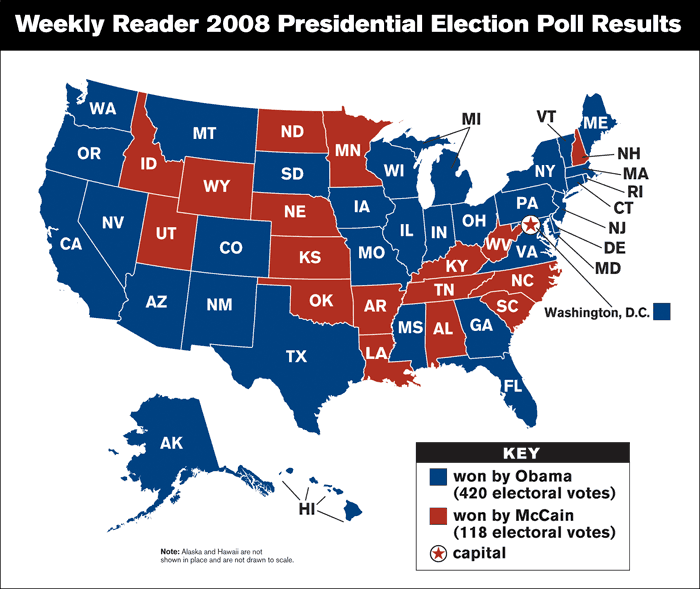
The American political system is essentially comprised of 2 political parties, who at their current state could not stand further apart on political issues. The government was organized into 3 separate branches as a means of eliminating any risk of a tyrannical leader (King George), I believe contemporary Americans forget this at times. In all reality the President of the United States is provides citizens with a face for America, but more importantly a scapegoat to blame issues on. President Obama won the 2008 in what turned out to be an absolute ass-kicking (he even won Indiana!), ultimately with such a resounding victory comes an extraordinary amount of expectation and pressure.
Presidential candidates in the United States run political campaigns that are fueled by both extraordinary claims and fiscal responsibility to interest groups. It is the job of the candidate to win over more voters than his/her opponent--something that is typically done through campaign platforms that cover nearly every issue that the American voter can identify with. President Obama was no different and noticed the growing salience of the environment within politics. During his campaign he made a number of promises regarding the environment, promises that's progress is being tracked at PolitiFact: Obama's Campaign Promises that are about the Environment. While going through the website, you notice that a large majority of the promises fall under the "In the Works" stage. I felt like "in the works" was quite a favorable term for many of the issues which will never even reach relevance. This is by no means an attack on President Obama, I personally voted for him and still believe that he is capable of getting the job done. However, I believe that this truly is a testament to the driving force behind politics, the economic climate. Political power is at its' peak when the economy is good or one party has a majority of members in congress. While the Democrats had a majority in congress, the economic outlook of America was grim, making legislation to get backed up through the power of the filibuster. The delay in achieving successful passing of legislation ultimately reorganized the goals of the Obama Administration and ultimately caused the outlook of passing progressive legislation (environmental) not as promising as was hoped. However, the passing of the American Recovery and Reinvestment Act (Stimulus Bill) allowed for the passing of nearly 79 billion dollars earmarked for green initiatives. The Senate version of this bill had earmarked nearly 50 billion dollars for coal and nuclear industries--needless to say this part of the bill did not make it to the President's desk. The final bill is expected to bring about nearly 3.5 million jobs within the "green-collar" industry--an important outlet within society as we continue to move towards more environmentally friendly initiatives. The bill's allocating of funds can be seen at www.recovery.gov .
While the President has the power of the item-line veto, they ultimately are second fiddle in comparison to the power of congress (who can over-rule the veto). However, President Obama has had success with many Senators and House of Representative members rising to power through the success of Obama. Ultimately, the existence of the bicameral legislature is to maintain that the president does not abuse their power. While President Obama does have the power of the veto and executive order (emancipation proclamation, most famously), during his first 100 days he was able to pass the stimulus package, in addition to calling attention to and reiteration his stance on several other environmental issues that are outlined here.
Ultimately, I personally feel as a Democrat who has voted for Obama somewhat disappointed at the backtracking that has happened since being in office. Granted, his initiatives are fueled by the economic standing of America, something that has not been favorable since he took office. As can be seen on the Politifact "Obamameter" link above, there exist many things that President Obama has either not yet gotten to, or has had to compromise to get the legislation past. While President Obama has the power to push through green initiatives, the political climate does not offer much of an opportunity with many other domestic and international issues taking precedent. Overall, I personally believe that priorities and the polarization of parties is something that will only perpetuate the current state of the economy. Politics ultimately comes down to money and within the current economic climate, in addition to the continuing loss of support for President Obama, I do not see a positive outlook for the environmental issues and campaign promises. While somewhat disappointed in Obama, it truly comes down to the organization of our government and the reluctance of individuals to do "the right thing" as a means of maintaining both part and constituent support. While President Obama has failed to implement "green initiatives" to the magnitude that was emphasized within his Presidential Campaign, he has been sidetracked with the passing of the Health Care Bill, as well as our continued presence in the middle east.
Presidential candidates in the United States run political campaigns that are fueled by both extraordinary claims and fiscal responsibility to interest groups. It is the job of the candidate to win over more voters than his/her opponent--something that is typically done through campaign platforms that cover nearly every issue that the American voter can identify with. President Obama was no different and noticed the growing salience of the environment within politics. During his campaign he made a number of promises regarding the environment, promises that's progress is being tracked at PolitiFact: Obama's Campaign Promises that are about the Environment. While going through the website, you notice that a large majority of the promises fall under the "In the Works" stage. I felt like "in the works" was quite a favorable term for many of the issues which will never even reach relevance. This is by no means an attack on President Obama, I personally voted for him and still believe that he is capable of getting the job done. However, I believe that this truly is a testament to the driving force behind politics, the economic climate. Political power is at its' peak when the economy is good or one party has a majority of members in congress. While the Democrats had a majority in congress, the economic outlook of America was grim, making legislation to get backed up through the power of the filibuster. The delay in achieving successful passing of legislation ultimately reorganized the goals of the Obama Administration and ultimately caused the outlook of passing progressive legislation (environmental) not as promising as was hoped. However, the passing of the American Recovery and Reinvestment Act (Stimulus Bill) allowed for the passing of nearly 79 billion dollars earmarked for green initiatives. The Senate version of this bill had earmarked nearly 50 billion dollars for coal and nuclear industries--needless to say this part of the bill did not make it to the President's desk. The final bill is expected to bring about nearly 3.5 million jobs within the "green-collar" industry--an important outlet within society as we continue to move towards more environmentally friendly initiatives. The bill's allocating of funds can be seen at www.recovery.gov .
While the President has the power of the item-line veto, they ultimately are second fiddle in comparison to the power of congress (who can over-rule the veto). However, President Obama has had success with many Senators and House of Representative members rising to power through the success of Obama. Ultimately, the existence of the bicameral legislature is to maintain that the president does not abuse their power. While President Obama does have the power of the veto and executive order (emancipation proclamation, most famously), during his first 100 days he was able to pass the stimulus package, in addition to calling attention to and reiteration his stance on several other environmental issues that are outlined here.
Ultimately, I personally feel as a Democrat who has voted for Obama somewhat disappointed at the backtracking that has happened since being in office. Granted, his initiatives are fueled by the economic standing of America, something that has not been favorable since he took office. As can be seen on the Politifact "Obamameter" link above, there exist many things that President Obama has either not yet gotten to, or has had to compromise to get the legislation past. While President Obama has the power to push through green initiatives, the political climate does not offer much of an opportunity with many other domestic and international issues taking precedent. Overall, I personally believe that priorities and the polarization of parties is something that will only perpetuate the current state of the economy. Politics ultimately comes down to money and within the current economic climate, in addition to the continuing loss of support for President Obama, I do not see a positive outlook for the environmental issues and campaign promises. While somewhat disappointed in Obama, it truly comes down to the organization of our government and the reluctance of individuals to do "the right thing" as a means of maintaining both part and constituent support. While President Obama has failed to implement "green initiatives" to the magnitude that was emphasized within his Presidential Campaign, he has been sidetracked with the passing of the Health Care Bill, as well as our continued presence in the middle east.
 |
| Will his environmental policies be enough to warrant such a picture? |

Government Regulation
My political approach has continually crept its way further and further left. It seems as though every morning while reading Politico or Huffington Post it takes very little effort to find examples of some entity within the United States abusing the somewhat laissez-faire approach that characterizes the United States within contemporary society. While conservatives argue that Obama's "Socialist Regime" will ultimately be the end of our the American free market--as I stated above, it does not take much to provide counterparts to their conservative drivel. As a liberal, I am a staunch believer in the role of government and their right to regulate nearly all aspects of our economy. These approaches to political dealings transcend into the realm of environmental matters--where I believe that regulation is a NECESSITY in order to maintain and conserve our environment. The environment is a topic within the political field that often gets overlooked when it comes to fiscal matters, however maintaining and adopting green initiatives is a necessary in order for the United States to maintain its title as the "World Leader". While the title has been slipping in recent years, the United States still sets the tone for movements throughout the world, making it essential that we change our approach to dealings with the environment.
The Republican party offers a Market Based Initiative(MBI) approach to solving environmental issues such as greenhouse gases, pollution and electricity. This approach is characterized by cap-and-trade system--a system that is designed to promote lower pollution, energy use etc. through the trading of credits, while also in typical Republican fashion, providing financial incentives to companies as a means of enticing them to move towards more efficient and green approaches. Providing credits for companies to trade (purchase) not only favors big business (shocking), but it also allows for companies to go about their business in a manner that does not necessarily put the environment first. Companies who find it financially smarter to continue to pollute, will continue to do so--while other companies may move towards green initiatives, the pollution levels within a cap-and-trade system are relatively similar throughout time and ultimately do not do enough to provide incentives to companies to move towards more eco-friendly business practices. While cap-and-trade does provide a "cap" on the overall pollution, it creates a market where credits are traded and thus can place a financial burden on companies. While the companies "pay" for the credits, this idea falls in line with the idea of companies paying for your social security. While it appears at the surface that the companies are paying for our social security, in all actuality they are using money that otherwise would have been your salary, ultimately costing nothing but the individual money. This same idea holds true within the cap-and-trade MBI, the cost of polluting/using fuel ultimately trickles down to the consumer, causing prices to go up for the common individual, while corporations continue to make profit.
As I stated above, as a liberal I find myself identifying with government intervention to solve issues that arise within the political realm. With regard to the environment I believe that the federal government needs to set into actions regulations that hold big business accountable for their pollution etc., in addition to setting state specific mandates that enable green initiatives to begin to become more mainstream throughout the United States. Although I staunchly believe that this is the approach that is necessary, I believe that there are many issues within society that make government regulation an effective idea rather than an effective means to solving current issues within the field of environmental politics. Ultiamtely, the polarization of political parties makes agenda setting an arduous task that encompasses much more time and effort than should be required. In addition, Republicans are now beginning to accept the fact that global warming is not some bat shit crazy idea, but in fact an issue that will plague politics with no end in sight. State and Federal Budgets also come into play and make an overhaul of the current system an unattainable idea--within the current state of the economy it is evident that the environment barely makes its way into the equation. While government regulation is a necessity, there exists too many schisms within the current political realm to make government regulation an effective means of dealing with the environment.
With MBI's ineffective, and a political climate that makes government regulation difficult--voluntary action begins to seem more and more legitimate as environmental issues continue to come to the surface. The 1960's brought about civil rights change through the implementation of grassroots movements that were not "top-down" initiatives, but rather the collective action of individuals with a common belief. Ultiamtely, "going green" is an idea that has encompassed contemporary culture. Contemporary society is characterized by individuals who drive fuel efficient cars, use the carpool lane, eat organic foods or use alternative energy, the catch: all these voluntary actions are characterized by high financial costs. Ultimately, the voluntary action movement pertaining to environmental politics is evident in society, but it is my personal belief that it is not more widespread due to the financial burden that "going green" and being "eco-smart" places on the average American within a society in a deep recession and with nearly 10% unemployment.
The realm of environmental politics offers many issues that will soon fine themselves dubbed "hot-button" issues in the future. However, our current political climate--polarization of parties, power of corporations and a continually growing national debt have made dealing with the environment more of a fad than an actuality. (See John McCain's Eco-Friendly Clothing). I personally believe that the answer lies within top-to-bottom government regulation. However, I believe that that idea coming to fruition is years away and we must continue to rely on the grassroots based initiatives through voluntary action by individuals to place pressure on local governments and regulations in order to bring salience to the countless issues that exist within this realm. Ultimately, I feel as though the actions taken by government have not been enough and we will continue to head towards a future that require immediate action a la social security reorganization that has still not been addressed. Ultimately, my political ideals line up with government intervention, but also account for the role of the individual and movements (which can be seen by mostly democrats partaking in outspoken political actions) and will continue to emphasize the role of the individual until the salience of this topic trumps domestic issues outside of helping corporate America.

The Republican party offers a Market Based Initiative(MBI) approach to solving environmental issues such as greenhouse gases, pollution and electricity. This approach is characterized by cap-and-trade system--a system that is designed to promote lower pollution, energy use etc. through the trading of credits, while also in typical Republican fashion, providing financial incentives to companies as a means of enticing them to move towards more efficient and green approaches. Providing credits for companies to trade (purchase) not only favors big business (shocking), but it also allows for companies to go about their business in a manner that does not necessarily put the environment first. Companies who find it financially smarter to continue to pollute, will continue to do so--while other companies may move towards green initiatives, the pollution levels within a cap-and-trade system are relatively similar throughout time and ultimately do not do enough to provide incentives to companies to move towards more eco-friendly business practices. While cap-and-trade does provide a "cap" on the overall pollution, it creates a market where credits are traded and thus can place a financial burden on companies. While the companies "pay" for the credits, this idea falls in line with the idea of companies paying for your social security. While it appears at the surface that the companies are paying for our social security, in all actuality they are using money that otherwise would have been your salary, ultimately costing nothing but the individual money. This same idea holds true within the cap-and-trade MBI, the cost of polluting/using fuel ultimately trickles down to the consumer, causing prices to go up for the common individual, while corporations continue to make profit.
As I stated above, as a liberal I find myself identifying with government intervention to solve issues that arise within the political realm. With regard to the environment I believe that the federal government needs to set into actions regulations that hold big business accountable for their pollution etc., in addition to setting state specific mandates that enable green initiatives to begin to become more mainstream throughout the United States. Although I staunchly believe that this is the approach that is necessary, I believe that there are many issues within society that make government regulation an effective idea rather than an effective means to solving current issues within the field of environmental politics. Ultiamtely, the polarization of political parties makes agenda setting an arduous task that encompasses much more time and effort than should be required. In addition, Republicans are now beginning to accept the fact that global warming is not some bat shit crazy idea, but in fact an issue that will plague politics with no end in sight. State and Federal Budgets also come into play and make an overhaul of the current system an unattainable idea--within the current state of the economy it is evident that the environment barely makes its way into the equation. While government regulation is a necessity, there exists too many schisms within the current political realm to make government regulation an effective means of dealing with the environment.
With MBI's ineffective, and a political climate that makes government regulation difficult--voluntary action begins to seem more and more legitimate as environmental issues continue to come to the surface. The 1960's brought about civil rights change through the implementation of grassroots movements that were not "top-down" initiatives, but rather the collective action of individuals with a common belief. Ultiamtely, "going green" is an idea that has encompassed contemporary culture. Contemporary society is characterized by individuals who drive fuel efficient cars, use the carpool lane, eat organic foods or use alternative energy, the catch: all these voluntary actions are characterized by high financial costs. Ultimately, the voluntary action movement pertaining to environmental politics is evident in society, but it is my personal belief that it is not more widespread due to the financial burden that "going green" and being "eco-smart" places on the average American within a society in a deep recession and with nearly 10% unemployment.
The realm of environmental politics offers many issues that will soon fine themselves dubbed "hot-button" issues in the future. However, our current political climate--polarization of parties, power of corporations and a continually growing national debt have made dealing with the environment more of a fad than an actuality. (See John McCain's Eco-Friendly Clothing). I personally believe that the answer lies within top-to-bottom government regulation. However, I believe that that idea coming to fruition is years away and we must continue to rely on the grassroots based initiatives through voluntary action by individuals to place pressure on local governments and regulations in order to bring salience to the countless issues that exist within this realm. Ultimately, I feel as though the actions taken by government have not been enough and we will continue to head towards a future that require immediate action a la social security reorganization that has still not been addressed. Ultimately, my political ideals line up with government intervention, but also account for the role of the individual and movements (which can be seen by mostly democrats partaking in outspoken political actions) and will continue to emphasize the role of the individual until the salience of this topic trumps domestic issues outside of helping corporate America.

Monday, September 6, 2010
My Philosophical Approach to the Environment
One’s individual responsibilities within the global spectrum are characteristic of one’s personal beliefs—creating an environment that features nearly unlimited perspectives and provides the groundwork for discrepancies when dealing with issues pertaining to the commons. Within contemporary society there exists a growing concern and knowledgebase pertaining to the environment and how we should approach dealings with our ecosystem. Within his book, The Politics of the Environment, Neil Carter outlines the many approaches that exist within the field of environmental philosophy. Upon reading through the many perspectives that exist I was able to find parallel ideas within the ecocentric approach. The ecocentric approach is characterized by placing both humans and non-humans on a level plateau when it comes to decision making within the environmental realm. Ultimately, the ecocentric approach provides a challenge to contemporary ideals--forcing humans to abandon an approach that features them at the top of the priority list, in order to include ideas pertaining to the environment within the rapidly changing global atmosphere. While I should point out that there are instances that exist within the global economy where humans hold the trump card (economic issues)—the progressive nature of contemporary society in my personal opinion is moving towards a more ecocentric approach. I find myself aligning with the ecocentric approach because I personally find it necessary to consider the environment in nearly all large-scale decisions made. A great deal of first world countries have come to economic power through the use of exploitation—whether it be less developed countries or the environment, there is often little policing when it comes to advancement, whether technological or economical. The world seems to have placed the burden of environmental understanding behind the importance of the dollar and has taken an anthropocentrism approach to these dealings. Anthropocentrism—the approach that places humans above any other entities (environment, animals) within the global spectrum with regard to decision making within both the political and professional world. The contemporary structure of society has made it difficult for the corporate world to include the environment in discussions—“going green” and recycling initiatives often are characterized by higher prices for consumers, something that is unthinkable in the current state of the U.S. economy (recession) and an extremely high rate of unemployment (almost 10%). In his chapter on Environmental philosophy, Neil Carter did an excellent job explaining the various philosophical approaches, especially when discussing the role of value—instrumental, inherent and intrinsic, that is the role that the environment plays in the varying perspectives as well as in one’s day-to-day life.
On the political scale I find myself on the left, both economically and socially. I am in favor of government intervention through the use of taxing as a means of reducing the socioeconomic disparities that characterize the current economic state within the United States. While I am not against a capitalistic nature of our economy, I feel it is necessary to have greater regulation than is characteristic of the modern day United States. The extreme fiscal discrepancies that exist within contemporary society, in my personal belief will continue to exist and get worse without more regulation of "big business" within the realm of politics and the professional world. Within the social realm I also consider myself to be a “liberal”, if you break everything down it is my personal belief that the answer to hot-button contemporary issues such as gay-marriage and the age-old abortion debate should all come down to personal choice. The feelings and ideas that people have are characteristic of the individual and it is truly my belief that there does not exist an entity powerful enough to regulate same-sex marriages or encounters--especially in the United States of America that grants these explicit powers to its' constituents through the Bill of Rights. I believe that the philosophical ecocentrism approach that I most closely identify with is extremely similar to my political beliefs. Similar to the way that anthropocentrism favors human interests above all, the Republican Party is often guilty of favoring the interests of corporate America (Yes a bit of a tangent, but hey it's my blog, might as well be authentic). A more Democratic approach to dealing with the environment is through an ecocentric approach—the idea of including all interests (human and environment) into the debate. Similar to the hot-button issues that exist within the social realm, the political left is at the base of the environmental movement. Ultimately, the political left has often been defined by its work within the field of environmental conservation, alternative fuels and the global warming debate. While there exist instances within the political realm where the environment is not at the forefront of debate, the ecocentric approach could most closely be linked with the political lefts approach—ideas that are consistent with my current political philosophy.
As a senior with only one semester left before I student teach, I would be ignorant if I said that I do not expect my political philosophy to change once I enter the professional world. However, one thing that I believe will stay the same is my approach and feelings towards dealings with the environment. The environment in itself is what provides us with the ability to go about our business. If the process of exploiting the environment continues society as a whole is in for a rude awakening. Ultimately, it is imperative to strive for aspects of environmental policy to be considered when discussing specific legislation. The environment needs to consistently make its’ way into the argument, in order for the ecocentric approach to become a mainstream idea instead of a philosophical approach.

On the political scale I find myself on the left, both economically and socially. I am in favor of government intervention through the use of taxing as a means of reducing the socioeconomic disparities that characterize the current economic state within the United States. While I am not against a capitalistic nature of our economy, I feel it is necessary to have greater regulation than is characteristic of the modern day United States. The extreme fiscal discrepancies that exist within contemporary society, in my personal belief will continue to exist and get worse without more regulation of "big business" within the realm of politics and the professional world. Within the social realm I also consider myself to be a “liberal”, if you break everything down it is my personal belief that the answer to hot-button contemporary issues such as gay-marriage and the age-old abortion debate should all come down to personal choice. The feelings and ideas that people have are characteristic of the individual and it is truly my belief that there does not exist an entity powerful enough to regulate same-sex marriages or encounters--especially in the United States of America that grants these explicit powers to its' constituents through the Bill of Rights. I believe that the philosophical ecocentrism approach that I most closely identify with is extremely similar to my political beliefs. Similar to the way that anthropocentrism favors human interests above all, the Republican Party is often guilty of favoring the interests of corporate America (Yes a bit of a tangent, but hey it's my blog, might as well be authentic). A more Democratic approach to dealing with the environment is through an ecocentric approach—the idea of including all interests (human and environment) into the debate. Similar to the hot-button issues that exist within the social realm, the political left is at the base of the environmental movement. Ultimately, the political left has often been defined by its work within the field of environmental conservation, alternative fuels and the global warming debate. While there exist instances within the political realm where the environment is not at the forefront of debate, the ecocentric approach could most closely be linked with the political lefts approach—ideas that are consistent with my current political philosophy.
As a senior with only one semester left before I student teach, I would be ignorant if I said that I do not expect my political philosophy to change once I enter the professional world. However, one thing that I believe will stay the same is my approach and feelings towards dealings with the environment. The environment in itself is what provides us with the ability to go about our business. If the process of exploiting the environment continues society as a whole is in for a rude awakening. Ultimately, it is imperative to strive for aspects of environmental policy to be considered when discussing specific legislation. The environment needs to consistently make its’ way into the argument, in order for the ecocentric approach to become a mainstream idea instead of a philosophical approach.

Subscribe to:
Posts (Atom)