Having missed the opportunity to discuss issues amongst my family members over break, the preparation of the group presentation that I will be apart of later this evening has placed the systematic monoculture nature of our agricultural sector to the forefront of my brain. This debate came to a head 2 days ago, as one of my roommates, who happens to have family members with a 3000+ acre farm outside of Fort Wayne, became the target of this assignment. I would consider myself to be a leftist, while my roommate is more likely a middle-of-the-road political supporter. However, to start our debate I through out a line that I knew would resonate, "the mono-culture nature of our agricultural sector is based off of economic factors and greed more so than wise agricultural practices." Immediately we got into a debate pertaining to which practice was more responsible and a rationale way to approach growing crops. As one would expect and an idea that is typical of political debates, if one is not entirely knowledgeable about a topic they can always rely on their knowledge and stance on economic issues in every debate. He countered with ideas pertaining to the fact that corn is a necessity because everything we have is in corn and the role of of government subsidies is an idea that allows farmers to make the most money from their crops--even noting that some summers his family's farm is not at capacity due to the governments ability to sway the decisions of farming practices. He also defended corn through the growing role of ethanol--a sustainable practice that only further legitimized the massive monoculture of corn, soybeans etc. in America. I quickly informed him that while ethanol is a a more effective "resource" than oil, the enviornmental impact is sizable. The corn still needs to be grown and processed into ethanol--an idea of the federal governments to further perpetuate our dependency on corn within the United States. The debate quickly turned from here to a debate on the use of chemicals and fertilizers. He felt as though it did not matter what chemicals or fertilizers were used either on his family farm or foods that he eats, stating that they make them more resistant to disease etc. It was here that I expressed to him that monoculture growing practices only encourage and create a more formidable atmosphere for disease and plight. The discussion then evolved into my informing him about Monsanto, a company that he had never heard of. I expressed to him about the idea of patented seeds, an idea which he felt was reasonable due to the research that goes in to developing seeds (he's going to medical school next year so I assumed this was an idea that he would support). I continued my assault on Monsanto expressing stories learned from the previous group presentation, identifying the fact that corn is pollinated through the wind, which causes the controlling of Monsanto patented seeds to be a difficult task. The threat to farmers who do not pay their yearly stipend to Monsanto was something that did still not deter him from his support of industrialized agricultural practices. Our debate concluded rather abruptly as we both agreed to disagree.
The debate shed light into the disconnect between the "general population" and those with a greater knowledge within the field of sustainable/green ideas and practices. It was interesting to see defense of our economic and government organization. I think this debate brought to the surface an idea that is common within contemporary society and that is the inability of Americans to realize that we are no longer "the world power" (a common thought of my roommates) and the idea that everything we do is the correct way. It seems as though within government and the population there is a solid movement to maintain our current practices. It is evident for anyone involved within the political environment that there exist glaring needs for improvement and change and the failure to do so will only perpetuate problems for future generations--one of the central ideas of the sustainable movement and an idea that resonates in nearly all political arenas.
Monday, December 6, 2010

Tuesday, November 30, 2010
Questions for Sanders
1. What is the typical response that you receive when talking to people about A Conservationist Manifesto?
2. How do you believe we should tackle the issues surrounding consumption? Additionally, what do you believe is the "easiest" adjustment that we can make within society to become more efficient and less wasteful?
3. What do you think Indiana University can do in order to become more sustainable as a university? Additionally, in what ways can they spread this message to students in an effective manner?
4. A Conservationist Manifesto is pretty much everything that the title would make one believe. I am just curious as to what steps you take within your personal life to live efficiently and environmentally sound?
2. How do you believe we should tackle the issues surrounding consumption? Additionally, what do you believe is the "easiest" adjustment that we can make within society to become more efficient and less wasteful?
3. What do you think Indiana University can do in order to become more sustainable as a university? Additionally, in what ways can they spread this message to students in an effective manner?
4. A Conservationist Manifesto is pretty much everything that the title would make one believe. I am just curious as to what steps you take within your personal life to live efficiently and environmentally sound?
Friday, November 5, 2010
Outline for Paper
Sustainable Education:
· Introduce Sustainable education
o Define Sustainability—I plan to use several definitions of sustainability to come up with an idea that I personally feel encompasses all the ideas of sustainability
o Why introduce these ideas in education?
o Provide statistics of current state of sustainable education, juxtapose these ideas with past numbers to show growing “progressive nature of society”
· Issues in Sustainability—ideas to approach
o Economic
o Cultural values
o Media and Sustainability
· Curriculum/case studies
o Elementary/middle
o Secondary
o Post-Secondary
o State Mandated Curriculum?/Legislation and funding for sustainable practices
· Case Studies
o Where/what practices were adopted
o Pedagogical practices
§ What is effective?
§ Which do I believe to be the most effective?
o Implementation outside classroom—organized action
§ Sustainable clubs/organizations
· Analysis
o What pedagogical practices were most effective?
§ Why?
§ Influence?
§ Ideology
o The future of sustainable education
Thesis*: Ideas of sustainable practices are a growing ideology within the realm of education. There are various pedagogical practices that exist within the field of education, however it is evident that some practices bring about a more effective means of learning.
*I first would like to state that my thesis is subject to change. I just recently changed to this topic and have not yet had a chance to look at the variety of pedagogical practices within the realm of sustainable education.
I plan to find my information through the use of the library sources (EBSCO etc). However, I have found from my limited research that there may be difficulty due to the contemporary nature of the topic. It seems that the stance of Indiana University has changed within my 4 years here. The growing salience of the topic is one that may cause me to result to complete research outside of scholarly articles and look towards personal accounts, articles and case studies. In the paper I want to provide instances throughout the educational experience (K-12, post-secondary), as well as look into the overall impact that this education has on changing ideology as well as real world application of ideas/practices discussed. Note that in the outline I wanted to address the impact of ideas within society, economics, values and the media. It seems these are three major things that dictate a lot of the ideas and issues within this "contemporary" idea.

Questions for Guest Speakers
Here were the questions that I had going into the discussion, although they were almost all alluded to throughout our conversation.
Emilie Rex
-What is Indiana University's carbon footprint? How does this measure with the rest of the Big Ten?
-How have departments cut down on their use of papers?
-Do you measure progress by comparing IU with other University's initiatives, or is sustainability typically measured on an individual basis?
Jacqui Butler
-What is the political climate like with regard to funding for sustainable intiaitives?
-What are the current initiatives in place to allow Bloomington to become a more efficient community?
- In comparison to neighboring towns, does the liberal nature of Bloomington allow for an easier experience implementing initiatives?
-How have you been spreading your message throughout Bloomington?
As I stated above these ideas were almost all addressed. Overall I found the speakers to be very interesting and somewhat disappointing once realizing the limited power that they have. Having an understanding of sustainable practices and realizing the little salience that they have within the political realm.
Emilie Rex
-What is Indiana University's carbon footprint? How does this measure with the rest of the Big Ten?
-How have departments cut down on their use of papers?
-Do you measure progress by comparing IU with other University's initiatives, or is sustainability typically measured on an individual basis?
Jacqui Butler
-What is the political climate like with regard to funding for sustainable intiaitives?
-What are the current initiatives in place to allow Bloomington to become a more efficient community?
- In comparison to neighboring towns, does the liberal nature of Bloomington allow for an easier experience implementing initiatives?
-How have you been spreading your message throughout Bloomington?
As I stated above these ideas were almost all addressed. Overall I found the speakers to be very interesting and somewhat disappointing once realizing the limited power that they have. Having an understanding of sustainable practices and realizing the little salience that they have within the political realm.
Monday, October 25, 2010
The New New Deal--Heavy Government Intervention
The process of developing my understanding of my utopian society was no easy task. Thinking about important issues and ideas that I would implement in my ideal world only brings to the surface the issues that are characteristic of modern society. However, approaching this idea through an environmentalist perspective provides an easier scope to such a broad and almost unattainable task.
The first thing that I would implement in my utopian society was my approach to politics. While I believe that America has a proper basis for providing representation based on the population, there exist too many outside influences that have the capability of pushing agendas that might not necessarily be reflective of the needs/wants of the American public. I would eliminate the role of big business in government (lobbying, campaign funding) and allow for the politicians to act freely and representative of their voting constituents. In addition, society would not be plagued by political commercials aimed at skewing votes and bashing opponents. This may be somewhat of a pet peeve, but I personally hate having to watch extreme political attacks while trying to watch my favorite program (and I'm sorry Indiana politicians, being a card carrying member of the NRA is typically something that politicians would not divulge). While this post is by no means a political manifesto, those are just two of the many issues that I see existing within our politics and would address those first in my utopian make-over of the United States.
My utopian society would offer great government intervention in the everyday lives of its citizens as a means of ensuring every citizen with the essentials for life. The goal of my government would be to elicit feelings of community that have become non-existent in the current state of American society. The economic structure of my society would offer initial equal salaries of all--with opportunities to earn bonuses for exceptional work. Radical? Yes, however the issues that exist within our current society are largely due to the economic discrepancies that exist which call into question "the American dream" and how this idea has been attainable to only a small portion of the population. Economic coupled with race issues often drive apart the sense of community as people either act in a selfish manner or do not understand/were not offered opportunities to live amongst a diverse population. As I re-read my writing I can tell that I am beginning to digress from the ultimate goal and that is to develop my understanding for a utopian approach to the environment.
It may be fairly evident by now that I am in favor of government intervention as a role of not only redistributing wealth, but providing services to the consumer that is not based on profit margins, quarterly reports, stock holder expectations, bonuses, salaries etc. As an entity within society that is representative of the population I feel as though it is in the best interest within my society for the government to regulate both food and water. Grocery stores would exist as they do today, but would offer less processed foods, as well as lowering prices to accommodate so that food does not maintain itself as such a heavy financial burden within my utopian society. Vices such as Alcohol and Tobacco would still exist, but at a much cheaper price so that those who choose to divulge in such practices are not making a great financial impact on their families everyday lives.
The emphasis and ultimate creation of community within my utopia would allow for the actions of people to be completed in a manner that acts for the community over the personal needs. In my utopia, recycling and sustainable practices would become mainstream ideas. Recycling would become a more efficient branch within society as there would exist a great influx in the shear numbers of products and participants in the practice. Corporate waste would be cut off through government intervention and corporations would no longer be disconnected from society, but would act in a manner that reflects the needs and ideas of the community. Everyday corporations, businesses, the family home etc. would be given allotted amounts of energy/water credits, forcing them to change their practices and not only adopt more sustainable ideas. More credits can be bought for a hefty price from the government, who in turn would take that money and invest into "green energy" such as solar and wind power. This practice would deter individuals from acting selfishly within the home and would bring more simplistic ideas to mainstream everyday practices, such as relying on sun(day)light or opening windows as a means of regulating temperatures within the home.
Progress within my utopia would no longer be judged by GDP, but rather by declining energy consumption. It would be the stated goal of the large community to act in ways that are responsible to the the environment and to the government (which coincidentally places a heavy emphasis on the environment). While somewhat radical in my thoughts with the idea of income distribution, I personally feel as though it is the cause of many issues within our current society and only fuels greed at both corporate and personal levels. The reduction in power of the corporation and the increased financial capabilities of the government offer constituents a government that is truly capable of implementing progressive ideas and funding promises made to the community. New initiatives started within my utopia would also be inherently green as car manufacturers would only offer hybrid and fuel-efficient cars to the public, while at the same time funneling "profits" into research for the betterment of their products and society. Likewise, buildings would offer more efficient initiatives to ensure a respectable relationship between my utopia and the environment.
Reading through my blog, it is evident to see that my utopia is extremely radical and not feasible in the current world that we live in. However, the thoughts listed above provide my belief in what would be a way to solve many issues that plague the contemporary state of both American lives, as well as the American poltiical realm. While heavy government intervention may be viewed as un-American, the growing disparities between socioeconomic status and the perpetual nature of these classes is an issue that has widely been overlooked in society. This in turn would eliminate feelings of dependency on consumerism and instead re-arrange our priorities and move towards more traditional values centered around family. within Approaching this idea with the environment in mind brought to the surface the many issues surrounding the topic that exist, and often go overlooked today. I welcome the criticism to these ideas and challenge the readers to provide other perspectives to addressing these issues and acting in a manner that increases the livelihood of the population as a whole.
PS--Outside of the enviornmental issues within my society, there would be a heavy emphasis on the role of education. As a future teacher it pains me when I seeing the realm of education continually falling victim to budget cuts due to the ease and lack of litigation that these ideas require. Within my utopia, educational funding would be excessive in nature and the process of learning would offer a much more interactive experience.

The first thing that I would implement in my utopian society was my approach to politics. While I believe that America has a proper basis for providing representation based on the population, there exist too many outside influences that have the capability of pushing agendas that might not necessarily be reflective of the needs/wants of the American public. I would eliminate the role of big business in government (lobbying, campaign funding) and allow for the politicians to act freely and representative of their voting constituents. In addition, society would not be plagued by political commercials aimed at skewing votes and bashing opponents. This may be somewhat of a pet peeve, but I personally hate having to watch extreme political attacks while trying to watch my favorite program (and I'm sorry Indiana politicians, being a card carrying member of the NRA is typically something that politicians would not divulge). While this post is by no means a political manifesto, those are just two of the many issues that I see existing within our politics and would address those first in my utopian make-over of the United States.
My utopian society would offer great government intervention in the everyday lives of its citizens as a means of ensuring every citizen with the essentials for life. The goal of my government would be to elicit feelings of community that have become non-existent in the current state of American society. The economic structure of my society would offer initial equal salaries of all--with opportunities to earn bonuses for exceptional work. Radical? Yes, however the issues that exist within our current society are largely due to the economic discrepancies that exist which call into question "the American dream" and how this idea has been attainable to only a small portion of the population. Economic coupled with race issues often drive apart the sense of community as people either act in a selfish manner or do not understand/were not offered opportunities to live amongst a diverse population. As I re-read my writing I can tell that I am beginning to digress from the ultimate goal and that is to develop my understanding for a utopian approach to the environment.
It may be fairly evident by now that I am in favor of government intervention as a role of not only redistributing wealth, but providing services to the consumer that is not based on profit margins, quarterly reports, stock holder expectations, bonuses, salaries etc. As an entity within society that is representative of the population I feel as though it is in the best interest within my society for the government to regulate both food and water. Grocery stores would exist as they do today, but would offer less processed foods, as well as lowering prices to accommodate so that food does not maintain itself as such a heavy financial burden within my utopian society. Vices such as Alcohol and Tobacco would still exist, but at a much cheaper price so that those who choose to divulge in such practices are not making a great financial impact on their families everyday lives.
The emphasis and ultimate creation of community within my utopia would allow for the actions of people to be completed in a manner that acts for the community over the personal needs. In my utopia, recycling and sustainable practices would become mainstream ideas. Recycling would become a more efficient branch within society as there would exist a great influx in the shear numbers of products and participants in the practice. Corporate waste would be cut off through government intervention and corporations would no longer be disconnected from society, but would act in a manner that reflects the needs and ideas of the community. Everyday corporations, businesses, the family home etc. would be given allotted amounts of energy/water credits, forcing them to change their practices and not only adopt more sustainable ideas. More credits can be bought for a hefty price from the government, who in turn would take that money and invest into "green energy" such as solar and wind power. This practice would deter individuals from acting selfishly within the home and would bring more simplistic ideas to mainstream everyday practices, such as relying on sun(day)light or opening windows as a means of regulating temperatures within the home.
Progress within my utopia would no longer be judged by GDP, but rather by declining energy consumption. It would be the stated goal of the large community to act in ways that are responsible to the the environment and to the government (which coincidentally places a heavy emphasis on the environment). While somewhat radical in my thoughts with the idea of income distribution, I personally feel as though it is the cause of many issues within our current society and only fuels greed at both corporate and personal levels. The reduction in power of the corporation and the increased financial capabilities of the government offer constituents a government that is truly capable of implementing progressive ideas and funding promises made to the community. New initiatives started within my utopia would also be inherently green as car manufacturers would only offer hybrid and fuel-efficient cars to the public, while at the same time funneling "profits" into research for the betterment of their products and society. Likewise, buildings would offer more efficient initiatives to ensure a respectable relationship between my utopia and the environment.
Reading through my blog, it is evident to see that my utopia is extremely radical and not feasible in the current world that we live in. However, the thoughts listed above provide my belief in what would be a way to solve many issues that plague the contemporary state of both American lives, as well as the American poltiical realm. While heavy government intervention may be viewed as un-American, the growing disparities between socioeconomic status and the perpetual nature of these classes is an issue that has widely been overlooked in society. This in turn would eliminate feelings of dependency on consumerism and instead re-arrange our priorities and move towards more traditional values centered around family. within Approaching this idea with the environment in mind brought to the surface the many issues surrounding the topic that exist, and often go overlooked today. I welcome the criticism to these ideas and challenge the readers to provide other perspectives to addressing these issues and acting in a manner that increases the livelihood of the population as a whole.
PS--Outside of the enviornmental issues within my society, there would be a heavy emphasis on the role of education. As a future teacher it pains me when I seeing the realm of education continually falling victim to budget cuts due to the ease and lack of litigation that these ideas require. Within my utopia, educational funding would be excessive in nature and the process of learning would offer a much more interactive experience.

Monday, October 4, 2010
A Conservationist Manifesto
Manifesto: a written statement declaring publicly the intentions, motives, or views of its issuer (Merriam Webster)
Looking at the word manifesto alone provides insight into what exactly The Conservationist Manifesto by Scott Russell Sanders might entail. The process of titling something with the term manifesto allows for the author to express their ideas in a manner that does not necessarily have to coincide with what is "politically correct" or what is viewed as an appropriate perspective. As the manifesto title would indicate, within his book, Scott Sanders calls into question the ideals and "progress" of both past and contemporary society and the role, or lack there of, that the environment plays within our day-to-day decisions.
Part I of the book is titled, Caring for the Earth and in this section of the book, Sanders introduces ideas that call into question the livelihood of "the American dream". Sanders introduces an example from Bloomington, in which the owner of a woods sells his property to a real estate developer. The American dream is characterized now by what is necessarily right moral, but rather what is easiest and most profitable. The current approach to our dealings with the environment often places the good old dollar ahead of the ecosystems, animals and forests. Sanders describes this approach to life as the "fraying of the fabric of life", arguing that "[the population] simply den[ies] there is any reason for concern, and the more the evidence piles up, the louder their denials" (6). Sanders presents account after account which emphasizes ideals such as greed and efficiency (not in the environmental sense) taking precedent over the one thing that makes our lives possible--the environment. He does not argue that the population as a whole should get along without using resources from the environment, rather he calls into question the degree to which we should use (pillage) the environment. The environment used to encompass the idea of the "commons"--an idea which was ultimately discarded as upper-class and well off citizens began to privatize the "new world" and having initially indentured servants and slaves to work their land. This idea has evolved into the current state of the economy where the upper-class are now multinational corporations and the workers comprised of the middle-class.
Sanders takes a shot a right-wing politics when he states that our politicians often discuss legislation that is "almost entirely about private wealth and private solutions" (30). This approach thus creates a cycle that when there is a need/problem or issue within society there is always somewhere to turn within the market. He gives the example of crime, instead of fixing crime there is always a security system, safer communities or purchasing a gun--there is always somewhere to turn, which only perpetuates the initial problem. Our ideas are continually distorted through media campaigns by corporations and interest groups supported by big business that ultimately dictate legislative practices. When issues arise in politics, politicians always go the fail safe--tax cuts, which provide the public with more money in their pockets, while making the rich even richer. When the environment makes it into the discussion and action is taken, it often complicates the lives of individuals and may cut into their pockets. Sanders provides the example of farmers in the state of Indiana, who when asked to regulate and revamp their use of pesticides by the government are quick to pass the buck by calling these actions "communist" in nature (38).
Within the chapter titled, "A Few Earthly Words", Sanders goes about analyzing and pointing out the discrepancies that exist between the true meaning of words and the current understanding of specific words and how we have evolved our language to meet our societal needs. He concludes the chapter with the following sentiment, "In order to bring the voice of the land into our councils and kitchens,we need to reclaim this evocative, sensuous, and earthly speech" (58). Part I of the book provides thorough insight into exactly what Sanders is trying to achieve within his manifesto. Society as a whole has become too disconnected with the environment and has let our personal and political agendas trump the entity that enables us to exist. Sanders objective seems to be somewhat idealistic in the sense that he calls into question our economic approach to life (why not? it's a manifesto), however I can identify with his frustration with the way that we approach our everyday lives, especially with the way in which corporations dictate such a large portion of society. Overall I feel as though his ideas are idealistic--ideas that I agree with, but ideas that are far too large and not fully attainable within the polarized nature of our political structure, in addition to the the trump card that is money, which ultimately lies in the hands of corporations and individuals whose private gains trump that of Sanders' perceived societal ideals. I believe that the ideas within Sanders' manifesto need to be taken for what they are--his perception of society, and should not be criticized for their lack of practicality, but taken for the excellent and deep insights that they truly are.
Looking at the word manifesto alone provides insight into what exactly The Conservationist Manifesto by Scott Russell Sanders might entail. The process of titling something with the term manifesto allows for the author to express their ideas in a manner that does not necessarily have to coincide with what is "politically correct" or what is viewed as an appropriate perspective. As the manifesto title would indicate, within his book, Scott Sanders calls into question the ideals and "progress" of both past and contemporary society and the role, or lack there of, that the environment plays within our day-to-day decisions.
Part I of the book is titled, Caring for the Earth and in this section of the book, Sanders introduces ideas that call into question the livelihood of "the American dream". Sanders introduces an example from Bloomington, in which the owner of a woods sells his property to a real estate developer. The American dream is characterized now by what is necessarily right moral, but rather what is easiest and most profitable. The current approach to our dealings with the environment often places the good old dollar ahead of the ecosystems, animals and forests. Sanders describes this approach to life as the "fraying of the fabric of life", arguing that "[the population] simply den[ies] there is any reason for concern, and the more the evidence piles up, the louder their denials" (6). Sanders presents account after account which emphasizes ideals such as greed and efficiency (not in the environmental sense) taking precedent over the one thing that makes our lives possible--the environment. He does not argue that the population as a whole should get along without using resources from the environment, rather he calls into question the degree to which we should use (pillage) the environment. The environment used to encompass the idea of the "commons"--an idea which was ultimately discarded as upper-class and well off citizens began to privatize the "new world" and having initially indentured servants and slaves to work their land. This idea has evolved into the current state of the economy where the upper-class are now multinational corporations and the workers comprised of the middle-class.
Sanders takes a shot a right-wing politics when he states that our politicians often discuss legislation that is "almost entirely about private wealth and private solutions" (30). This approach thus creates a cycle that when there is a need/problem or issue within society there is always somewhere to turn within the market. He gives the example of crime, instead of fixing crime there is always a security system, safer communities or purchasing a gun--there is always somewhere to turn, which only perpetuates the initial problem. Our ideas are continually distorted through media campaigns by corporations and interest groups supported by big business that ultimately dictate legislative practices. When issues arise in politics, politicians always go the fail safe--tax cuts, which provide the public with more money in their pockets, while making the rich even richer. When the environment makes it into the discussion and action is taken, it often complicates the lives of individuals and may cut into their pockets. Sanders provides the example of farmers in the state of Indiana, who when asked to regulate and revamp their use of pesticides by the government are quick to pass the buck by calling these actions "communist" in nature (38).
Within the chapter titled, "A Few Earthly Words", Sanders goes about analyzing and pointing out the discrepancies that exist between the true meaning of words and the current understanding of specific words and how we have evolved our language to meet our societal needs. He concludes the chapter with the following sentiment, "In order to bring the voice of the land into our councils and kitchens,we need to reclaim this evocative, sensuous, and earthly speech" (58). Part I of the book provides thorough insight into exactly what Sanders is trying to achieve within his manifesto. Society as a whole has become too disconnected with the environment and has let our personal and political agendas trump the entity that enables us to exist. Sanders objective seems to be somewhat idealistic in the sense that he calls into question our economic approach to life (why not? it's a manifesto), however I can identify with his frustration with the way that we approach our everyday lives, especially with the way in which corporations dictate such a large portion of society. Overall I feel as though his ideas are idealistic--ideas that I agree with, but ideas that are far too large and not fully attainable within the polarized nature of our political structure, in addition to the the trump card that is money, which ultimately lies in the hands of corporations and individuals whose private gains trump that of Sanders' perceived societal ideals. I believe that the ideas within Sanders' manifesto need to be taken for what they are--his perception of society, and should not be criticized for their lack of practicality, but taken for the excellent and deep insights that they truly are.
Wednesday, September 29, 2010
Questions for Class--9/29/10
-How should the government approach dealings with corporations at fault when the local economy is dependent on that specific business? Does the government always have to bite the bullet to maintain smaller-populations dependent the jobs corporations provide?
-Is this idea of "balance" within the media even attainable? While most people knowingly choose their media that is slanted towards their political ideology, does the same hold true within the realm of science?
-Where should scientific research funding come from? It seems no matter where finance comes from, their is always an agenda attached. Is there any objective information pertaining to global warming?
-Is it right to present information through a lens that might mislead the public, but ultimately provide for improvements within society?
-Is this idea of "balance" within the media even attainable? While most people knowingly choose their media that is slanted towards their political ideology, does the same hold true within the realm of science?
-Where should scientific research funding come from? It seems no matter where finance comes from, their is always an agenda attached. Is there any objective information pertaining to global warming?
-Is it right to present information through a lens that might mislead the public, but ultimately provide for improvements within society?
Monday, September 27, 2010
Presidential Success?
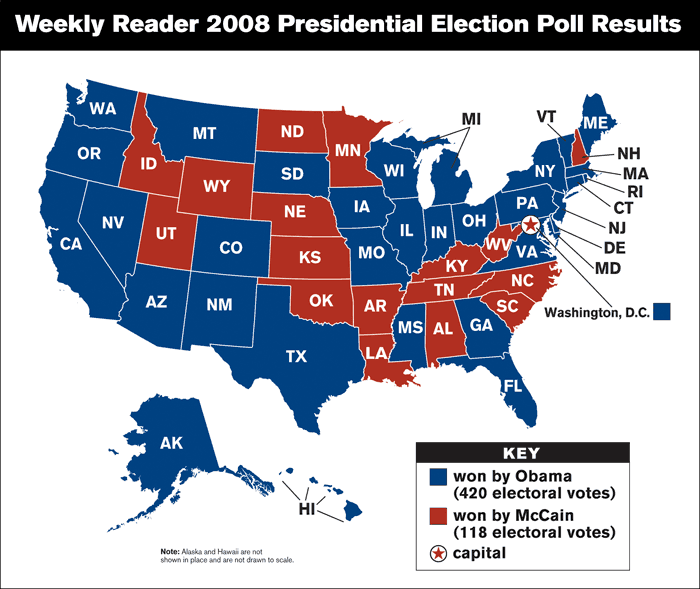
The American political system is essentially comprised of 2 political parties, who at their current state could not stand further apart on political issues. The government was organized into 3 separate branches as a means of eliminating any risk of a tyrannical leader (King George), I believe contemporary Americans forget this at times. In all reality the President of the United States is provides citizens with a face for America, but more importantly a scapegoat to blame issues on. President Obama won the 2008 in what turned out to be an absolute ass-kicking (he even won Indiana!), ultimately with such a resounding victory comes an extraordinary amount of expectation and pressure.
Presidential candidates in the United States run political campaigns that are fueled by both extraordinary claims and fiscal responsibility to interest groups. It is the job of the candidate to win over more voters than his/her opponent--something that is typically done through campaign platforms that cover nearly every issue that the American voter can identify with. President Obama was no different and noticed the growing salience of the environment within politics. During his campaign he made a number of promises regarding the environment, promises that's progress is being tracked at PolitiFact: Obama's Campaign Promises that are about the Environment. While going through the website, you notice that a large majority of the promises fall under the "In the Works" stage. I felt like "in the works" was quite a favorable term for many of the issues which will never even reach relevance. This is by no means an attack on President Obama, I personally voted for him and still believe that he is capable of getting the job done. However, I believe that this truly is a testament to the driving force behind politics, the economic climate. Political power is at its' peak when the economy is good or one party has a majority of members in congress. While the Democrats had a majority in congress, the economic outlook of America was grim, making legislation to get backed up through the power of the filibuster. The delay in achieving successful passing of legislation ultimately reorganized the goals of the Obama Administration and ultimately caused the outlook of passing progressive legislation (environmental) not as promising as was hoped. However, the passing of the American Recovery and Reinvestment Act (Stimulus Bill) allowed for the passing of nearly 79 billion dollars earmarked for green initiatives. The Senate version of this bill had earmarked nearly 50 billion dollars for coal and nuclear industries--needless to say this part of the bill did not make it to the President's desk. The final bill is expected to bring about nearly 3.5 million jobs within the "green-collar" industry--an important outlet within society as we continue to move towards more environmentally friendly initiatives. The bill's allocating of funds can be seen at www.recovery.gov .
While the President has the power of the item-line veto, they ultimately are second fiddle in comparison to the power of congress (who can over-rule the veto). However, President Obama has had success with many Senators and House of Representative members rising to power through the success of Obama. Ultimately, the existence of the bicameral legislature is to maintain that the president does not abuse their power. While President Obama does have the power of the veto and executive order (emancipation proclamation, most famously), during his first 100 days he was able to pass the stimulus package, in addition to calling attention to and reiteration his stance on several other environmental issues that are outlined here.
Ultimately, I personally feel as a Democrat who has voted for Obama somewhat disappointed at the backtracking that has happened since being in office. Granted, his initiatives are fueled by the economic standing of America, something that has not been favorable since he took office. As can be seen on the Politifact "Obamameter" link above, there exist many things that President Obama has either not yet gotten to, or has had to compromise to get the legislation past. While President Obama has the power to push through green initiatives, the political climate does not offer much of an opportunity with many other domestic and international issues taking precedent. Overall, I personally believe that priorities and the polarization of parties is something that will only perpetuate the current state of the economy. Politics ultimately comes down to money and within the current economic climate, in addition to the continuing loss of support for President Obama, I do not see a positive outlook for the environmental issues and campaign promises. While somewhat disappointed in Obama, it truly comes down to the organization of our government and the reluctance of individuals to do "the right thing" as a means of maintaining both part and constituent support. While President Obama has failed to implement "green initiatives" to the magnitude that was emphasized within his Presidential Campaign, he has been sidetracked with the passing of the Health Care Bill, as well as our continued presence in the middle east.
Presidential candidates in the United States run political campaigns that are fueled by both extraordinary claims and fiscal responsibility to interest groups. It is the job of the candidate to win over more voters than his/her opponent--something that is typically done through campaign platforms that cover nearly every issue that the American voter can identify with. President Obama was no different and noticed the growing salience of the environment within politics. During his campaign he made a number of promises regarding the environment, promises that's progress is being tracked at PolitiFact: Obama's Campaign Promises that are about the Environment. While going through the website, you notice that a large majority of the promises fall under the "In the Works" stage. I felt like "in the works" was quite a favorable term for many of the issues which will never even reach relevance. This is by no means an attack on President Obama, I personally voted for him and still believe that he is capable of getting the job done. However, I believe that this truly is a testament to the driving force behind politics, the economic climate. Political power is at its' peak when the economy is good or one party has a majority of members in congress. While the Democrats had a majority in congress, the economic outlook of America was grim, making legislation to get backed up through the power of the filibuster. The delay in achieving successful passing of legislation ultimately reorganized the goals of the Obama Administration and ultimately caused the outlook of passing progressive legislation (environmental) not as promising as was hoped. However, the passing of the American Recovery and Reinvestment Act (Stimulus Bill) allowed for the passing of nearly 79 billion dollars earmarked for green initiatives. The Senate version of this bill had earmarked nearly 50 billion dollars for coal and nuclear industries--needless to say this part of the bill did not make it to the President's desk. The final bill is expected to bring about nearly 3.5 million jobs within the "green-collar" industry--an important outlet within society as we continue to move towards more environmentally friendly initiatives. The bill's allocating of funds can be seen at www.recovery.gov .
While the President has the power of the item-line veto, they ultimately are second fiddle in comparison to the power of congress (who can over-rule the veto). However, President Obama has had success with many Senators and House of Representative members rising to power through the success of Obama. Ultimately, the existence of the bicameral legislature is to maintain that the president does not abuse their power. While President Obama does have the power of the veto and executive order (emancipation proclamation, most famously), during his first 100 days he was able to pass the stimulus package, in addition to calling attention to and reiteration his stance on several other environmental issues that are outlined here.
Ultimately, I personally feel as a Democrat who has voted for Obama somewhat disappointed at the backtracking that has happened since being in office. Granted, his initiatives are fueled by the economic standing of America, something that has not been favorable since he took office. As can be seen on the Politifact "Obamameter" link above, there exist many things that President Obama has either not yet gotten to, or has had to compromise to get the legislation past. While President Obama has the power to push through green initiatives, the political climate does not offer much of an opportunity with many other domestic and international issues taking precedent. Overall, I personally believe that priorities and the polarization of parties is something that will only perpetuate the current state of the economy. Politics ultimately comes down to money and within the current economic climate, in addition to the continuing loss of support for President Obama, I do not see a positive outlook for the environmental issues and campaign promises. While somewhat disappointed in Obama, it truly comes down to the organization of our government and the reluctance of individuals to do "the right thing" as a means of maintaining both part and constituent support. While President Obama has failed to implement "green initiatives" to the magnitude that was emphasized within his Presidential Campaign, he has been sidetracked with the passing of the Health Care Bill, as well as our continued presence in the middle east.
 |
| Will his environmental policies be enough to warrant such a picture? |

Government Regulation
My political approach has continually crept its way further and further left. It seems as though every morning while reading Politico or Huffington Post it takes very little effort to find examples of some entity within the United States abusing the somewhat laissez-faire approach that characterizes the United States within contemporary society. While conservatives argue that Obama's "Socialist Regime" will ultimately be the end of our the American free market--as I stated above, it does not take much to provide counterparts to their conservative drivel. As a liberal, I am a staunch believer in the role of government and their right to regulate nearly all aspects of our economy. These approaches to political dealings transcend into the realm of environmental matters--where I believe that regulation is a NECESSITY in order to maintain and conserve our environment. The environment is a topic within the political field that often gets overlooked when it comes to fiscal matters, however maintaining and adopting green initiatives is a necessary in order for the United States to maintain its title as the "World Leader". While the title has been slipping in recent years, the United States still sets the tone for movements throughout the world, making it essential that we change our approach to dealings with the environment.
The Republican party offers a Market Based Initiative(MBI) approach to solving environmental issues such as greenhouse gases, pollution and electricity. This approach is characterized by cap-and-trade system--a system that is designed to promote lower pollution, energy use etc. through the trading of credits, while also in typical Republican fashion, providing financial incentives to companies as a means of enticing them to move towards more efficient and green approaches. Providing credits for companies to trade (purchase) not only favors big business (shocking), but it also allows for companies to go about their business in a manner that does not necessarily put the environment first. Companies who find it financially smarter to continue to pollute, will continue to do so--while other companies may move towards green initiatives, the pollution levels within a cap-and-trade system are relatively similar throughout time and ultimately do not do enough to provide incentives to companies to move towards more eco-friendly business practices. While cap-and-trade does provide a "cap" on the overall pollution, it creates a market where credits are traded and thus can place a financial burden on companies. While the companies "pay" for the credits, this idea falls in line with the idea of companies paying for your social security. While it appears at the surface that the companies are paying for our social security, in all actuality they are using money that otherwise would have been your salary, ultimately costing nothing but the individual money. This same idea holds true within the cap-and-trade MBI, the cost of polluting/using fuel ultimately trickles down to the consumer, causing prices to go up for the common individual, while corporations continue to make profit.
As I stated above, as a liberal I find myself identifying with government intervention to solve issues that arise within the political realm. With regard to the environment I believe that the federal government needs to set into actions regulations that hold big business accountable for their pollution etc., in addition to setting state specific mandates that enable green initiatives to begin to become more mainstream throughout the United States. Although I staunchly believe that this is the approach that is necessary, I believe that there are many issues within society that make government regulation an effective idea rather than an effective means to solving current issues within the field of environmental politics. Ultiamtely, the polarization of political parties makes agenda setting an arduous task that encompasses much more time and effort than should be required. In addition, Republicans are now beginning to accept the fact that global warming is not some bat shit crazy idea, but in fact an issue that will plague politics with no end in sight. State and Federal Budgets also come into play and make an overhaul of the current system an unattainable idea--within the current state of the economy it is evident that the environment barely makes its way into the equation. While government regulation is a necessity, there exists too many schisms within the current political realm to make government regulation an effective means of dealing with the environment.
With MBI's ineffective, and a political climate that makes government regulation difficult--voluntary action begins to seem more and more legitimate as environmental issues continue to come to the surface. The 1960's brought about civil rights change through the implementation of grassroots movements that were not "top-down" initiatives, but rather the collective action of individuals with a common belief. Ultiamtely, "going green" is an idea that has encompassed contemporary culture. Contemporary society is characterized by individuals who drive fuel efficient cars, use the carpool lane, eat organic foods or use alternative energy, the catch: all these voluntary actions are characterized by high financial costs. Ultimately, the voluntary action movement pertaining to environmental politics is evident in society, but it is my personal belief that it is not more widespread due to the financial burden that "going green" and being "eco-smart" places on the average American within a society in a deep recession and with nearly 10% unemployment.
The realm of environmental politics offers many issues that will soon fine themselves dubbed "hot-button" issues in the future. However, our current political climate--polarization of parties, power of corporations and a continually growing national debt have made dealing with the environment more of a fad than an actuality. (See John McCain's Eco-Friendly Clothing). I personally believe that the answer lies within top-to-bottom government regulation. However, I believe that that idea coming to fruition is years away and we must continue to rely on the grassroots based initiatives through voluntary action by individuals to place pressure on local governments and regulations in order to bring salience to the countless issues that exist within this realm. Ultimately, I feel as though the actions taken by government have not been enough and we will continue to head towards a future that require immediate action a la social security reorganization that has still not been addressed. Ultimately, my political ideals line up with government intervention, but also account for the role of the individual and movements (which can be seen by mostly democrats partaking in outspoken political actions) and will continue to emphasize the role of the individual until the salience of this topic trumps domestic issues outside of helping corporate America.

The Republican party offers a Market Based Initiative(MBI) approach to solving environmental issues such as greenhouse gases, pollution and electricity. This approach is characterized by cap-and-trade system--a system that is designed to promote lower pollution, energy use etc. through the trading of credits, while also in typical Republican fashion, providing financial incentives to companies as a means of enticing them to move towards more efficient and green approaches. Providing credits for companies to trade (purchase) not only favors big business (shocking), but it also allows for companies to go about their business in a manner that does not necessarily put the environment first. Companies who find it financially smarter to continue to pollute, will continue to do so--while other companies may move towards green initiatives, the pollution levels within a cap-and-trade system are relatively similar throughout time and ultimately do not do enough to provide incentives to companies to move towards more eco-friendly business practices. While cap-and-trade does provide a "cap" on the overall pollution, it creates a market where credits are traded and thus can place a financial burden on companies. While the companies "pay" for the credits, this idea falls in line with the idea of companies paying for your social security. While it appears at the surface that the companies are paying for our social security, in all actuality they are using money that otherwise would have been your salary, ultimately costing nothing but the individual money. This same idea holds true within the cap-and-trade MBI, the cost of polluting/using fuel ultimately trickles down to the consumer, causing prices to go up for the common individual, while corporations continue to make profit.
As I stated above, as a liberal I find myself identifying with government intervention to solve issues that arise within the political realm. With regard to the environment I believe that the federal government needs to set into actions regulations that hold big business accountable for their pollution etc., in addition to setting state specific mandates that enable green initiatives to begin to become more mainstream throughout the United States. Although I staunchly believe that this is the approach that is necessary, I believe that there are many issues within society that make government regulation an effective idea rather than an effective means to solving current issues within the field of environmental politics. Ultiamtely, the polarization of political parties makes agenda setting an arduous task that encompasses much more time and effort than should be required. In addition, Republicans are now beginning to accept the fact that global warming is not some bat shit crazy idea, but in fact an issue that will plague politics with no end in sight. State and Federal Budgets also come into play and make an overhaul of the current system an unattainable idea--within the current state of the economy it is evident that the environment barely makes its way into the equation. While government regulation is a necessity, there exists too many schisms within the current political realm to make government regulation an effective means of dealing with the environment.
With MBI's ineffective, and a political climate that makes government regulation difficult--voluntary action begins to seem more and more legitimate as environmental issues continue to come to the surface. The 1960's brought about civil rights change through the implementation of grassroots movements that were not "top-down" initiatives, but rather the collective action of individuals with a common belief. Ultiamtely, "going green" is an idea that has encompassed contemporary culture. Contemporary society is characterized by individuals who drive fuel efficient cars, use the carpool lane, eat organic foods or use alternative energy, the catch: all these voluntary actions are characterized by high financial costs. Ultimately, the voluntary action movement pertaining to environmental politics is evident in society, but it is my personal belief that it is not more widespread due to the financial burden that "going green" and being "eco-smart" places on the average American within a society in a deep recession and with nearly 10% unemployment.
The realm of environmental politics offers many issues that will soon fine themselves dubbed "hot-button" issues in the future. However, our current political climate--polarization of parties, power of corporations and a continually growing national debt have made dealing with the environment more of a fad than an actuality. (See John McCain's Eco-Friendly Clothing). I personally believe that the answer lies within top-to-bottom government regulation. However, I believe that that idea coming to fruition is years away and we must continue to rely on the grassroots based initiatives through voluntary action by individuals to place pressure on local governments and regulations in order to bring salience to the countless issues that exist within this realm. Ultimately, I feel as though the actions taken by government have not been enough and we will continue to head towards a future that require immediate action a la social security reorganization that has still not been addressed. Ultimately, my political ideals line up with government intervention, but also account for the role of the individual and movements (which can be seen by mostly democrats partaking in outspoken political actions) and will continue to emphasize the role of the individual until the salience of this topic trumps domestic issues outside of helping corporate America.

Monday, September 6, 2010
My Philosophical Approach to the Environment
One’s individual responsibilities within the global spectrum are characteristic of one’s personal beliefs—creating an environment that features nearly unlimited perspectives and provides the groundwork for discrepancies when dealing with issues pertaining to the commons. Within contemporary society there exists a growing concern and knowledgebase pertaining to the environment and how we should approach dealings with our ecosystem. Within his book, The Politics of the Environment, Neil Carter outlines the many approaches that exist within the field of environmental philosophy. Upon reading through the many perspectives that exist I was able to find parallel ideas within the ecocentric approach. The ecocentric approach is characterized by placing both humans and non-humans on a level plateau when it comes to decision making within the environmental realm. Ultimately, the ecocentric approach provides a challenge to contemporary ideals--forcing humans to abandon an approach that features them at the top of the priority list, in order to include ideas pertaining to the environment within the rapidly changing global atmosphere. While I should point out that there are instances that exist within the global economy where humans hold the trump card (economic issues)—the progressive nature of contemporary society in my personal opinion is moving towards a more ecocentric approach. I find myself aligning with the ecocentric approach because I personally find it necessary to consider the environment in nearly all large-scale decisions made. A great deal of first world countries have come to economic power through the use of exploitation—whether it be less developed countries or the environment, there is often little policing when it comes to advancement, whether technological or economical. The world seems to have placed the burden of environmental understanding behind the importance of the dollar and has taken an anthropocentrism approach to these dealings. Anthropocentrism—the approach that places humans above any other entities (environment, animals) within the global spectrum with regard to decision making within both the political and professional world. The contemporary structure of society has made it difficult for the corporate world to include the environment in discussions—“going green” and recycling initiatives often are characterized by higher prices for consumers, something that is unthinkable in the current state of the U.S. economy (recession) and an extremely high rate of unemployment (almost 10%). In his chapter on Environmental philosophy, Neil Carter did an excellent job explaining the various philosophical approaches, especially when discussing the role of value—instrumental, inherent and intrinsic, that is the role that the environment plays in the varying perspectives as well as in one’s day-to-day life.
On the political scale I find myself on the left, both economically and socially. I am in favor of government intervention through the use of taxing as a means of reducing the socioeconomic disparities that characterize the current economic state within the United States. While I am not against a capitalistic nature of our economy, I feel it is necessary to have greater regulation than is characteristic of the modern day United States. The extreme fiscal discrepancies that exist within contemporary society, in my personal belief will continue to exist and get worse without more regulation of "big business" within the realm of politics and the professional world. Within the social realm I also consider myself to be a “liberal”, if you break everything down it is my personal belief that the answer to hot-button contemporary issues such as gay-marriage and the age-old abortion debate should all come down to personal choice. The feelings and ideas that people have are characteristic of the individual and it is truly my belief that there does not exist an entity powerful enough to regulate same-sex marriages or encounters--especially in the United States of America that grants these explicit powers to its' constituents through the Bill of Rights. I believe that the philosophical ecocentrism approach that I most closely identify with is extremely similar to my political beliefs. Similar to the way that anthropocentrism favors human interests above all, the Republican Party is often guilty of favoring the interests of corporate America (Yes a bit of a tangent, but hey it's my blog, might as well be authentic). A more Democratic approach to dealing with the environment is through an ecocentric approach—the idea of including all interests (human and environment) into the debate. Similar to the hot-button issues that exist within the social realm, the political left is at the base of the environmental movement. Ultimately, the political left has often been defined by its work within the field of environmental conservation, alternative fuels and the global warming debate. While there exist instances within the political realm where the environment is not at the forefront of debate, the ecocentric approach could most closely be linked with the political lefts approach—ideas that are consistent with my current political philosophy.
As a senior with only one semester left before I student teach, I would be ignorant if I said that I do not expect my political philosophy to change once I enter the professional world. However, one thing that I believe will stay the same is my approach and feelings towards dealings with the environment. The environment in itself is what provides us with the ability to go about our business. If the process of exploiting the environment continues society as a whole is in for a rude awakening. Ultimately, it is imperative to strive for aspects of environmental policy to be considered when discussing specific legislation. The environment needs to consistently make its’ way into the argument, in order for the ecocentric approach to become a mainstream idea instead of a philosophical approach.

On the political scale I find myself on the left, both economically and socially. I am in favor of government intervention through the use of taxing as a means of reducing the socioeconomic disparities that characterize the current economic state within the United States. While I am not against a capitalistic nature of our economy, I feel it is necessary to have greater regulation than is characteristic of the modern day United States. The extreme fiscal discrepancies that exist within contemporary society, in my personal belief will continue to exist and get worse without more regulation of "big business" within the realm of politics and the professional world. Within the social realm I also consider myself to be a “liberal”, if you break everything down it is my personal belief that the answer to hot-button contemporary issues such as gay-marriage and the age-old abortion debate should all come down to personal choice. The feelings and ideas that people have are characteristic of the individual and it is truly my belief that there does not exist an entity powerful enough to regulate same-sex marriages or encounters--especially in the United States of America that grants these explicit powers to its' constituents through the Bill of Rights. I believe that the philosophical ecocentrism approach that I most closely identify with is extremely similar to my political beliefs. Similar to the way that anthropocentrism favors human interests above all, the Republican Party is often guilty of favoring the interests of corporate America (Yes a bit of a tangent, but hey it's my blog, might as well be authentic). A more Democratic approach to dealing with the environment is through an ecocentric approach—the idea of including all interests (human and environment) into the debate. Similar to the hot-button issues that exist within the social realm, the political left is at the base of the environmental movement. Ultimately, the political left has often been defined by its work within the field of environmental conservation, alternative fuels and the global warming debate. While there exist instances within the political realm where the environment is not at the forefront of debate, the ecocentric approach could most closely be linked with the political lefts approach—ideas that are consistent with my current political philosophy.
As a senior with only one semester left before I student teach, I would be ignorant if I said that I do not expect my political philosophy to change once I enter the professional world. However, one thing that I believe will stay the same is my approach and feelings towards dealings with the environment. The environment in itself is what provides us with the ability to go about our business. If the process of exploiting the environment continues society as a whole is in for a rude awakening. Ultimately, it is imperative to strive for aspects of environmental policy to be considered when discussing specific legislation. The environment needs to consistently make its’ way into the argument, in order for the ecocentric approach to become a mainstream idea instead of a philosophical approach.

Subscribe to:
Posts (Atom)